CAG-ICSSR Colloquium
STATE OF FINANCE OF KERALA AND WASTE MANAGEMENT IN URBAN LOCAL BODIES
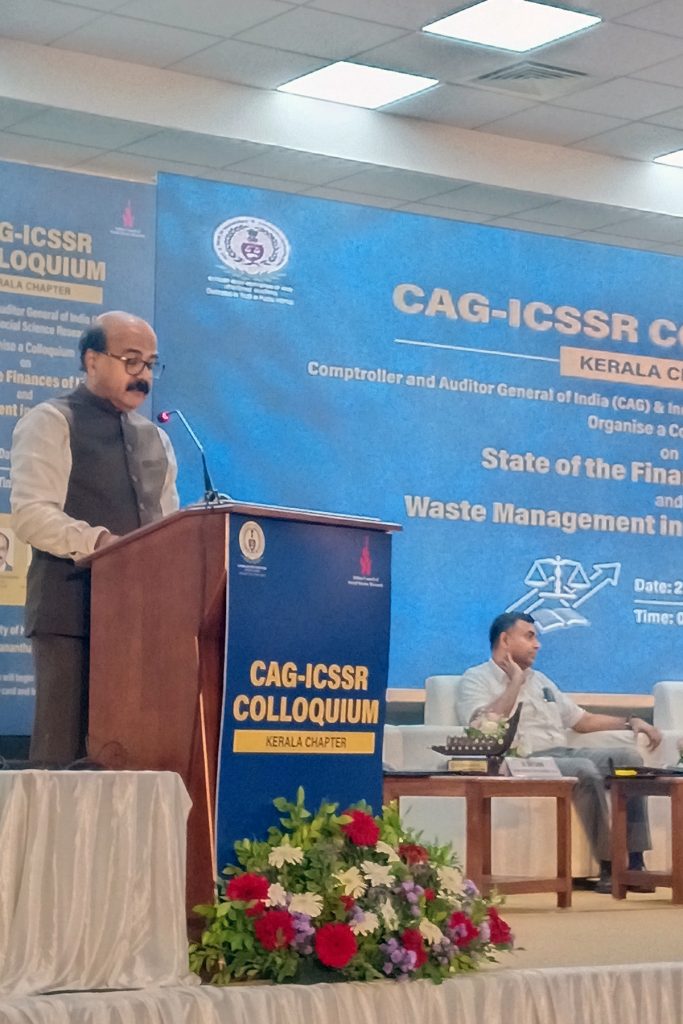
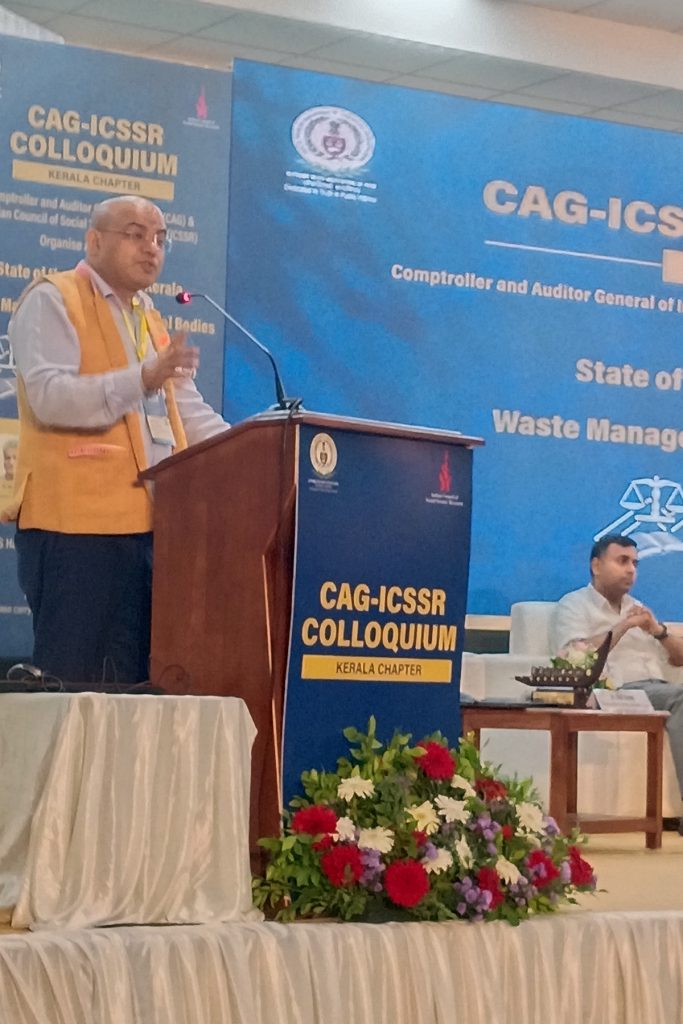
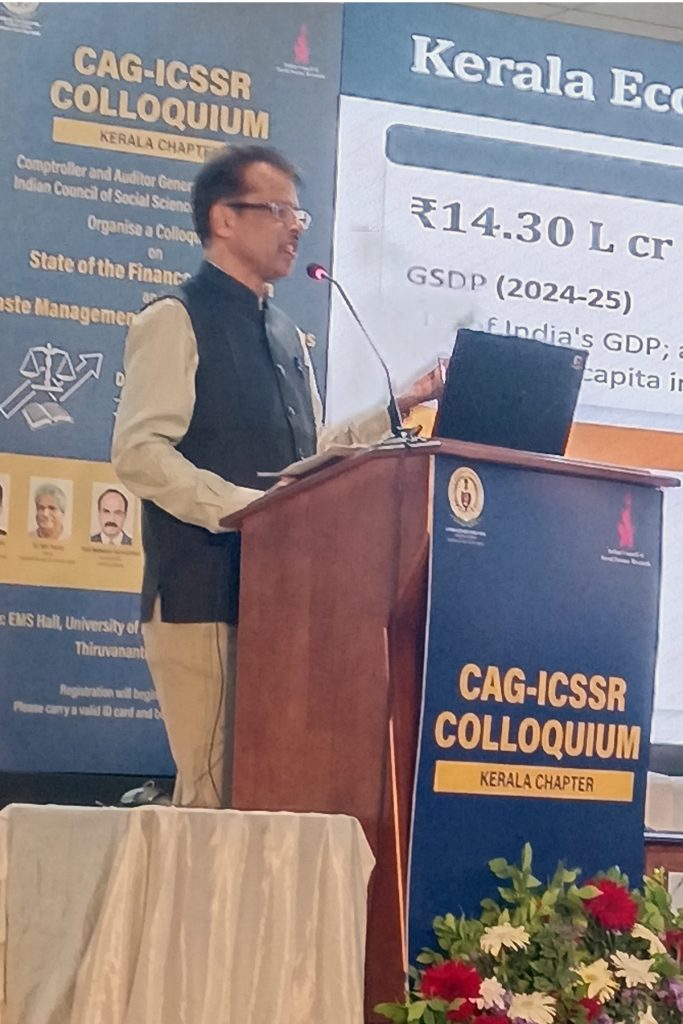
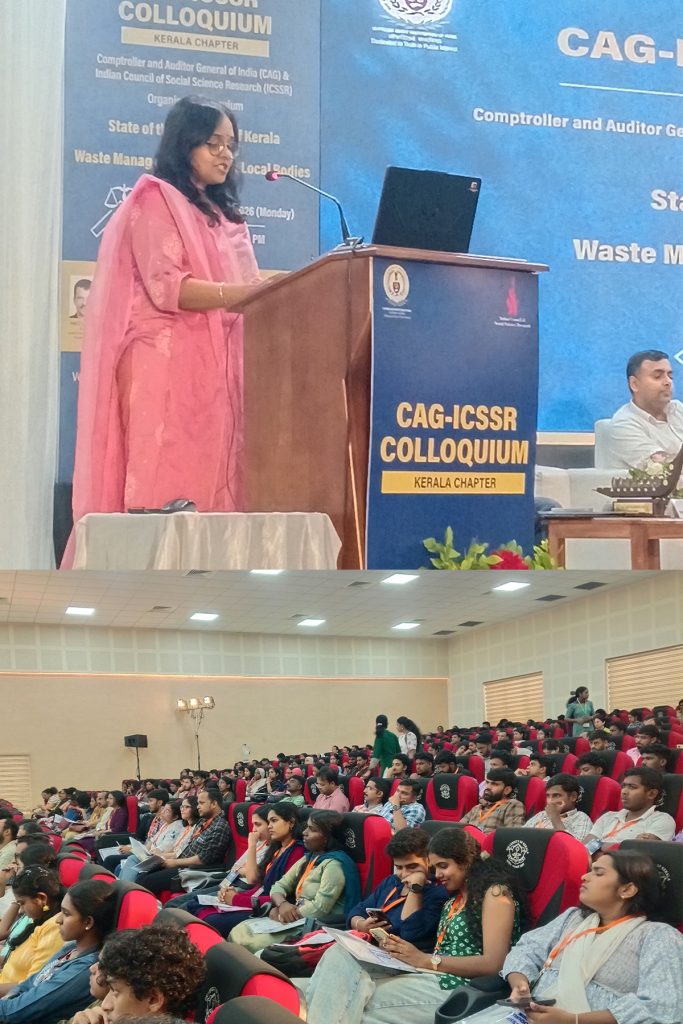
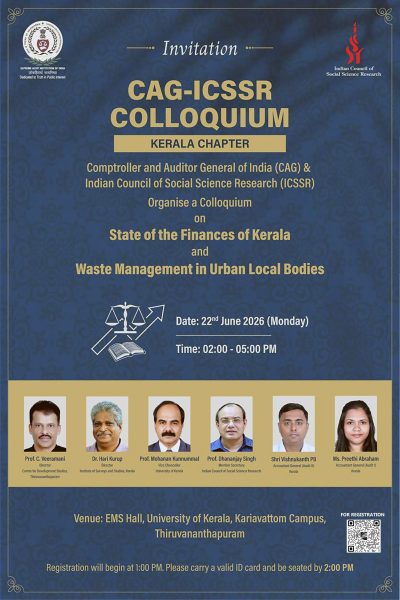
The CAG–ICSSR Colloquium was held on 22 June 2026 at University of Kerala, Kariavattom Campus, Thiruvananthapuram marking a significant collaborative initiative between the Comptroller and Auditor General of India (CAG) and the Indian Council of Social Science Research (ICSSR). The colloquium brought together policymakers, auditors, academics, researchers, and students for meaningful deliberations on two important public policy concerns: “State of Finances of Kerala” and “Waste Management in Urban Local Bodies.”
The colloquium was inaugurated by Prof. Mohanan Kunnummal, Vice Chancellor, University of Kerala. The keynote sessions featured distinguished speakers including Prof. Dhananjay Singh, Member Secretary, Indian Council of Social Science Research (ICSSR); Ms. Preethi Abraham, Accountant General (Audit I), Kerala; Shri Vishnukanth P.B., Accountant General (Audit II), Kerala; Prof. C. Veeramani, Director, Centre for Development Studies (CDS), Thiruvananthapuram; and Dr. Hari Kurup, Director, Institute of Studies and Surveys, Kerala. Ms. Akhika B.S., Deputy Accountant General, Office of the Accountant General (A&E), Kerala, also addressed the gathering.
The sessions provided a platform for detailed discussions on Kerala’s fiscal position, sustainability of public finances, challenges in urban waste management, and the role of institutional mechanisms in improving governance outcomes. Speakers underlined the significance of public audit reports as a foundation for academic research and policy formulation.
The event concluded with a vote of thanks proposed by Dr. Amartya Paul, Assistant Professor, CDS. Dr. Ritika Jain, Associate Professor, CDS, moderated the sessions.
Background and Objectives of the Colloquium
Purpose of the CAG–ICSSR Initiative
The colloquium was organized as part of the Comptroller and Auditor General of India’s broader national initiative to democratize access to public audit data and promote its use in academic research and public policy analysis. Through its partnership with the ICSSR, the CAG seeks to ensure that the insights and evidence contained in audit reports are leveraged not only for legislative scrutiny and accountability but also for advancing scholarly inquiry, fostering evidence-based policymaking, and deepening public understanding of governance and development challenges. This initiative reflects a growing commitment to strengthening the interface between public institutions and academia for the creation of impactful, policy-relevant research.
Relevance for Kerala and Public Policy
Given Kerala’s position as a leader in human development, education, and health outcomes, addressing emerging governance and fiscal challenges is critical for sustaining its developmental achievements and ensuring long-term economic resilience. The themes selected for the colloquium State Finances of Kerala and Waste Management in Urban Local Bodies reflect two interconnected dimensions of the State’s development trajectory. While Kerala has achieved remarkable social progress, concerns regarding rising debt levels, high committed expenditure, declining revenue buoyancy, and limited fiscal space pose significant challenges to sustaining public investment and welfare outcomes.
At the same time, rapid urbanisation is placing increasing pressure on local governments to deliver essential services, particularly in areas such as waste management, sanitation, public health, and urban infrastructure. The discussions highlighted the need for stronger fiscal management, enhanced revenue mobilisation, data-driven governance, institutional reforms, and improved accountability mechanisms. By bringing together insights from public audit, academic research, and policy practice, the colloquium contributed to a deeper understanding of these challenges and explored pathways for strengthening evidence-based policymaking, fiscal sustainability, and sustainable urban development in Kerala.
Technical Session I: State of Finances of Kerala
This session was led by Shri Vishnukanth PB: Accountant General (Audit II), Kerala, followed by Prof. C Veeramani: Director, Centre for Development Studies, Thiruvananthapuram, Kerala.
Major Issues Discussed:
- Development Fiscal Paradox: Kerala continues to record some of the country’s best social development outcomes in health, education, and human development. However, these achievements coexist with mounting fiscal pressures, including high debt levels, rising committed expenditure, and limited fiscal flexibility.
- Weakening Revenue Base: Revenue receipts as a share of GSDP have declined in recent years. The State remains heavily dependent on GST collections, while central tax devolution and grants have moderated. Kerala’s tax buoyancy was found to be lower than the average of major Indian states.
- High Committed Expenditure: Salaries, pensions, and interest payments constitute a significant share of government expenditure, accounting for nearly ₹98,000 crore in 2024–25. This limits the fiscal space available for developmental and discretionary spending.
- Low Capital Expenditure: Around 90 per cent of total expenditure is revenue expenditure, leaving only about 10 per cent for capital expenditure. Kerala’s capital spending remains below the average of major Indian states, raising concerns about long-term growth and infrastructure creation.
- Fiscal Deficit and Debt: Revenue and fiscal deficits widened during 2024–25 as expenditure growth outpaced revenue growth. The debt-GSDP ratio remained elevated at around 35.7 per cent, exceeding the prescribed target under the fiscal responsibility framework.
- Borrowing Pattern: A substantial share of government borrowing is being used to finance current expenditure rather than productive asset creation. This raises concerns regarding the quality of fiscal deficit and long-term debt sustainability.
- Structural Challenges: Demographic ageing, high educated unemployment, dependence on remittances, and a relatively weak manufacturing base were identified as structural factors influencing Kerala’s fiscal position and growth prospects.
- Policy Priorities: The session highlighted the need to strengthen revenue mobilisation, improve tax buoyancy, rationalise expenditure, enhance the performance of public sector enterprises, and increase productive capital expenditure to ensure fiscal sustainability and support long-term economic growth.
Technical Session II: Waste Management in Urban Local Bodies
This session was led by Ms. Preethi Abraham: Accountant General (Audit I), Kerala, followed by Dr. Hari Kurup, Director, Institute of Studies and Surveys, Kerala.
Major Issues Discussed:
- Urbanisation and Growing Service Delivery Demands: Kerala is undergoing rapid urbanisation, with the urban population projected to increase from 47.5 per cent in 2011 to 65.8 per cent by 2026, creating growing demands for waste management, housing, mobility, water supply, and sanitation services.
- Scale of the Waste Management Challenge: Kerala generates approximately 11,000 tonnes of waste daily, amounting to 3.7 million tonnes annually, of which 2.17 million tonnes originate from Urban Local Bodies (ULBs). Nearly 69 per cent of this waste is biodegradable, indicating substantial potential for decentralized composting and biogas systems that remains underutilised.
- Planning and Governance Deficits: The CAG audit found that none of the sampled ULBs had undertaken scientific assessments of waste generation and composition. As a result, 11 ULBs failed to access ₹45.82 crore in central assistance due to delays in preparing Detailed Project Reports and the absence of robust planning frameworks.
- Low Spending and Underutilisation of Funds: Although guidelines recommend allocating 10–15 per cent of development expenditure to solid waste management, actual spending by sampled ULBs ranged from only 0.48 per cent to 1.66 per cent. Further, 14 ULBs utilised only ₹1.85 crore out of ₹14.46 crore collected as service cess, while utilisation of Swachh Bharat Mission funds remained at just 23.46 per cent.
- Infrastructure and Operational Gaps: Inadequate source segregation, incomplete door-to-door collection, non-functional composting and biogas facilities, and the absence of a fully compliant sanitary landfill continue to hamper waste management outcomes. The audit also identified 14 dumpsites awaiting remediation and ₹3.35 crore of infructuous expenditure on non-functional waste-processing infrastructure.
- Urban Fiscal Capacity and Revenue Mobilisation: Despite rising devolution to local governments: from ₹7,269 crore in 2014–15 to ₹15,205 crore in 2024–25; ULBs remain highly dependent on transfers. The session highlighted significant scope for enhancing own-source revenues through better administration of property taxes, professional taxes, user charges, and other local levies.
- Data-Driven Governance and Institutional Innovation: Speakers stressed the importance of strengthening digital governance through initiatives such as K-SMART, GIS-based planning, local government dashboards, open-budget systems, and improved local-level data availability to support evidence-based policymaking and service delivery.
- Towards Sustainable Urban Governance: The session called for a transition from waste disposal to resource recovery, stronger regional cooperation among ULBs, integration of Haritha Karma Sena workers into formal social protection systems, and institutional reforms that improve accountability, fiscal sustainability, and environmental resilience in Kerala’s rapidly urbanising regions.
The CAG–ICSSR Colloquium demonstrated the value of collaboration between constitutional institutions and academia in addressing pressing public policy challenges. Through substantive discussions on Kerala’s fiscal health and waste management in urban local bodies, the event highlighted the importance of fiscal sustainability, effective urban governance, data-driven decision-making, and public accountability for sustaining the State’s development achievements. The colloquium underscored the role of public audit as a source of evidence for research and policymaking, while also encouraging greater engagement of students and scholars with governance issues. By fostering informed dialogue among policymakers, auditors, academics, and researchers, the colloquium contributed to a deeper understanding of Kerala’s development challenges and helped identify pathways towards more sustainable, transparent, and evidence-based governance.