
Start
September 30, 2026 - 3:30 pm
End
September 30, 2026 - 5:00 pm
Address
Joan Robinson Hall, CDS View map
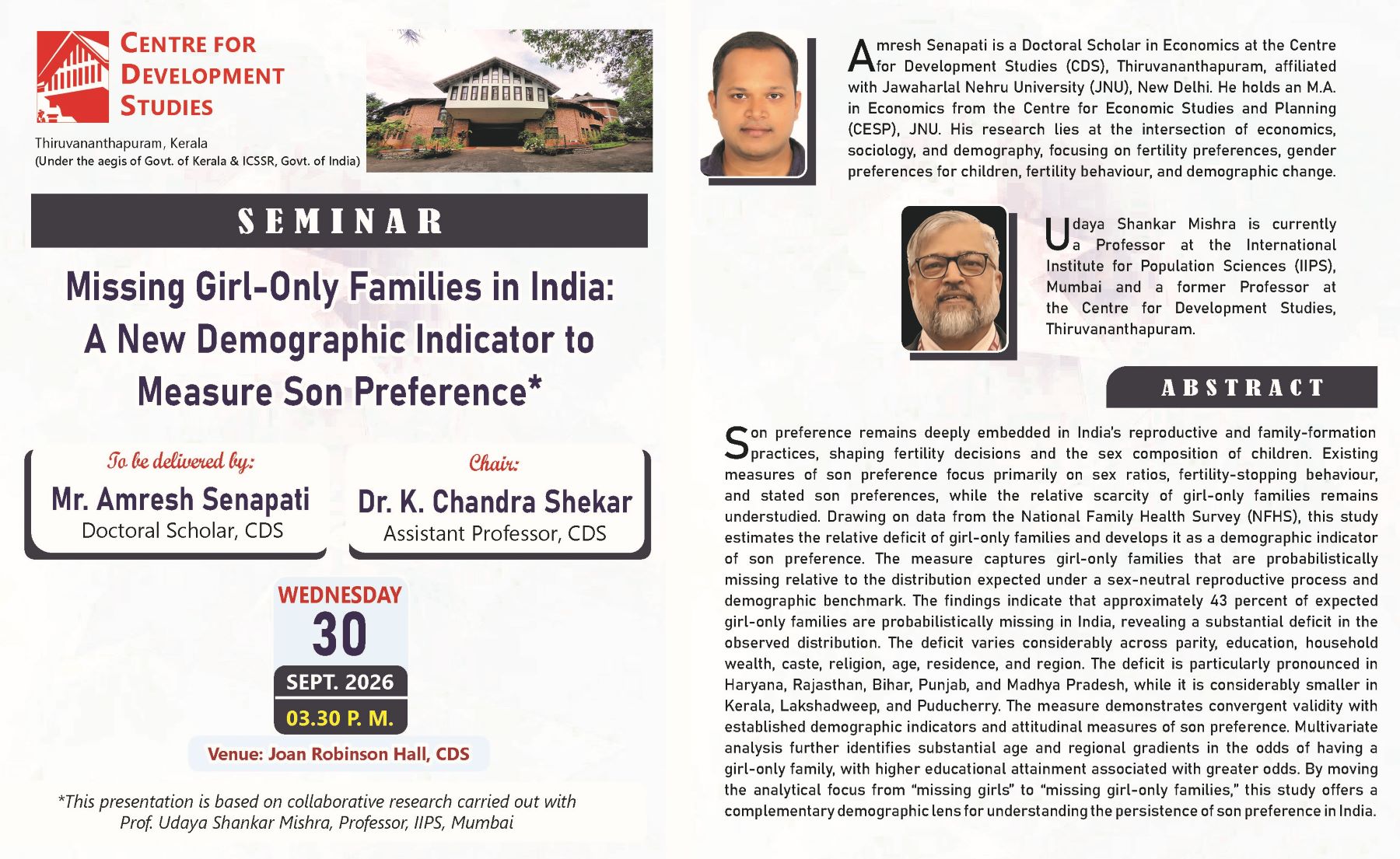
Title of the Presentation: Missing Girl-Only Families in India: A New Demographic Indicator to Measure Son Preference
To be delivered by: Amresh Senapati
Chair: Dr. K. Chandra Shekar
Missing Girl-Only Families in India: A New Demographic Indicator to Measure Son Preference
ABSTRACT
Son preference remains deeply embedded in India’s reproductive and family-formation practices, shaping fertility decisions and the sex composition of children. Existing measures of son preference focus primarily on sex ratios, fertility-stopping behaviour, and stated son preferences, while the relative scarcity of girl-only families remains understudied. Drawing on data from the National Family Health Survey (NFHS), this study estimates the relative deficit of girl-only families and develops it as a demographic indicator of son preference. The measure captures girl-only families that are probabilistically missing relative to the distribution expected under a sex-neutral reproductive process and demographic benchmark. The findings indicate that approximately 43 percent of expected girl-only families are probabilistically missing in India, revealing a substantial deficit in the observed distribution. The deficit varies considerably across parity, education, household wealth, caste, religion, age, residence, and region. The deficit is particularly pronounced in Haryana, Rajasthan, Bihar, Punjab, and Madhya Pradesh, while it is considerably smaller in Kerala, Lakshadweep, and Puducherry. The measure demonstrates convergent validity with established demographic indicators and attitudinal measures of son preference. Multivariate analysis further identifies substantial age and regional gradients in the odds of having a girl-only family, with higher educational attainment associated with greater odds. By moving the analytical focus from “missing girls” to “missing girl-only families,” this study offers a complementary demographic lens for understanding the persistence of son preference in India.